An initiative by
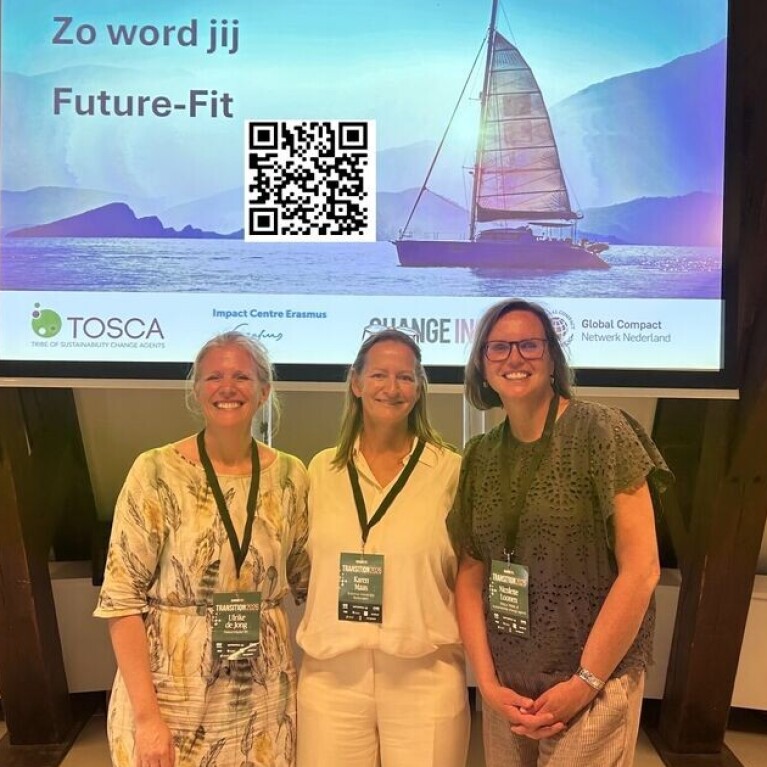
Over the past four weeks, we hosted four Future-Fit Preview Sessions, with Prof. Rob van Tulder (RSM) and Prof. Karen Maas (Impact Centre Erasmus) for business leaders and decision-makers from a wide range of companies and organizations. Together, we explored what it takes to build future-fit organizations, exchanged perspectives, and discussed the opportunities and challenges ahead.
These sessions started with reflections on our research we conducted together with Change Inc. and Impact Centre Erasmus. You can read the whitepaper: 'De duurzame transitie in Nederland 2026' with the result of the research among 307 senior decision-makers across Dutch organizations here.
The findings are quite interesting. 83% of organizations have sustainability goals. Yet only 19% are held accountable for them. And 56% measure their impact.
The gap between ambition and realization is not a knowledge problem. It is a structural one, in strategy, governance, and capacity.
Based on our research we identified three implications for organizations to become Future-Fit:
Why Future-Fit? What Does It Actually Mean?
We are living in a complex world which is volatile, uncertain, complex and ambiguous. The cost of inaction is rising fast: regulatory pressure, talent expectations, investor scrutiny, and reputational risk. Purpose-driven organizations are not just more sustainable, they are more resilient, more innovative, and ultimately more competitive.
This is why becoming Future-Fit is essential
A Future-Fit organization takes societal needs as its starting point, not as an afterthought. It repositions its value proposition, redesigns its operations for agility and impact, and translates strategy into an executable approach. The journey runs from ambition through strategy, implementation and output, all the way to measurable societal impact. Most organizations stop somewhere in the middle. The question is: where are you pausing, and why?
How Do You Become Future-Fit?
Rob van Tulder outlined six axes for the journey:
The route you take depends on where you are. Organizations that are at the beginning of this journey should apply a more responsive route, building on external pressure. Whereas companies that are already taking steps are ready for the capabilities route, learning by doing. A few are ready for the collaborative route, driving systemic change together with others.
The Role of Change Agents
One of the most energizing parts of each session was the conversation about who drives this transformation inside an organization. Not the strategy document. Not the ESG report. People. A change agent is not a job title. It is a profile, a combination of attitude, capability and behavior. The eight defining characteristics:
The question we posed in every session: what are the main characteristics where you score yourself strong and which characteristics do you need to further develop.
Key Performance Illusions: What to watch out for
Karen Maas brought one of the sharpest challenges of the sessions: we are measuring ourselves into a false sense of progress. KPIs then become Key Performance Illusions.
Albert Einstein said it plainly: "Not everything that can be counted, counts — and not everything that counts can be counted." Edward Deming added: "Nothing becomes more important just because you can measure it. It becomes more measurable, that's all."
The most common performance illusions:
The shift that needs to take place moves from what have we done? to what has changed? From inputs and activities to outcomes and impact. KPIs that reflect your impact are the KPIs that actually tell you something.
The Future-Fit Accelerator: Structure and why to Join
The Future-Fit Accelerator is our answer to the structural gap between ambition and realization. Not a course. Not a one-day workshop. A 12-month transformation program, built on the scientific knowledge of Impact Centre Erasmus, combined with TOSCA's hands-on experience when working with organizational.
How it is structured:
The program runs two parallel tracks.
The In-Company Track supports each organization individually
The Share & Learn Track brings the cohort of five to ten organizations together
Six reasons to join:
We start in September 2026. The cohort is deliberately small. If you are considering joining, now is the moment to explore whether this is the right fit for your organization.
Curious? We would love to have a conversation — no obligation, just exploration. [e-mail us: info@toscatribe.nl] | [Download the brochure] | [Visit futurefitaccelerator.com]
Ulrike de Jong & Nicolette Loonen, TOSCA In collaboration with Prof. Rob van Tulder (RSM) and Prof. Karen Maas (Impact Centre Erasmus)